
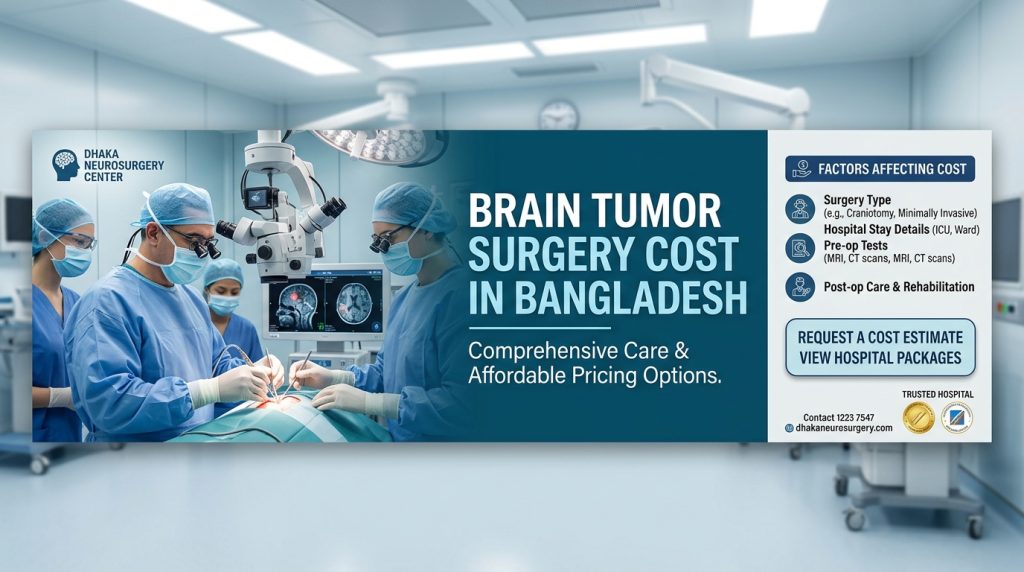

Navigating Brain Tumor Surgery Costs in Bangladesh
Receiving a brain tumor diagnosis is one of the most overwhelming experiences a patient and their family can face. Beyond the emotional burden, the sudden realization of complex medical treatments brings immediate financial concerns. In Bangladesh, where the majority of healthcare expenses are borne out-of-pocket, understanding the cost of brain tumor surgery is essential for effective financial planning and making informed treatment choices.
The cost of neurosurgery in Bangladesh varies widely based on factors such as the choice between public and private healthcare facilities, the complexity and location of the tumor, and the duration of post-operative intensive care.
1. Understanding the Baseline Financial Landscape
The overall expense of treating a brain tumor cannot be summarized by a single figure. Instead, it is a multi-layered financial puzzle that shifts significantly depending on where and how the procedure is performed.
In Bangladesh, the core surgical procedure typically ranges from BDT 80,000 to BDT 400,000 in mainstream public facilities and mid-tier private settings. However, for highly complex or aggressive tumors requiring advanced private multi-disciplinary care, high-end private medical facilities can see total bills climb between BDT 500,000 and BDT 800,000+.
The fundamental division in pricing stems from the healthcare delivery model:
The Public Healthcare Sector
Government-run institutions offer highly subsidized medical services. For citizens with restricted financial means, these hospitals represent a vital lifeline. The surgical fee itself is kept to a absolute minimum, often covered by state allocations. However, the patient’s family must frequently purchase specialized surgical consumables, specific medications, and external diagnostic tests out-of-pocket if the hospital’s central supply is depleted.
The Private Healthcare Sector
Private hospitals operate on a fee-for-service model. While they offer rapid access to treatment, shorter wait lists, and comfortable accommodations, they charge market rates for every single asset utilized—from the minute spent in the operating theater to the precise milligram of anesthesia administered.
2. Core Operational Estimates: Public vs. Private Sectors
To assist families in assessing potential liabilities, the table below provides a detailed comparison of estimated price points across public and private tiers in Bangladesh.
| Expense Category | Government / Public Tier (e.g., NINH, DMCH, BSMMU) | Mid-Tier Private Facilities | High-End Private Tier (e.g., Evercare, Square, United) |
| Pre-Operative Diagnostics | BDT 10,000 – BDT 25,000 | BDT 25,000 – BDT 45,000 | BDT 50,000 – BDT 80,000 |
| Core Surgical & Surgeon Fee | BDT 20,000 – BDT 50,000 | BDT 120,000 – BDT 200,000 | BDT 25,0000 – BDT 450,000 |
| OT Charges & Anesthesia | BDT 10,000 – BDT 20,000 | BDT 40,000 – BDT 70,000 | BDT 80,000 – BDT 150,000 |
| Daily ICU / Neuro-ICU Rate | BDT 5,000 – BDT 10,000 | BDT 15,000 – BDT 30,000 | BDT 45,000 – BDT 75,000 |
| Standard Ward Stay (Per Day) | BDT 500 – BDT 2,000 | BDT 4,000 – BDT 8,000 | BDT 10,000 – BDT 18,000 |
| Post-Op Histopathology | BDT 3,000 – BDT 6,000 | BDT 6,000 – BDT 10,000 | BDT 12,000 – BDT 20,000 |
| Estimated Total Hospital Bill | BDT 80,000 – BDT 200,000 | BDT 250,000 – BDT 450,000 | BDT 500,000 – BDT 800,000+ |
Note: These are estimates reflecting standard, uncomplicated surgical pathways. Complications, prolonged ventilator dependency, or the necessity of specialized imported implants can alter final billing significantly.
3. Key Cost Drivers in Brain Tumor Surgery
The final balance on a hospital ledger is determined by several clinical and administrative variables. Understanding these components can help families anticipate costs.
Tumor Classification and Anatomical Mapping
The surgical approach depends on whether a tumor is benign (non-cancerous) or malignant (cancerous), as well as its precise location. A superficial, well-demarcated meningioma located on the cerebral cortex is technically easier to resect than a deeply embedded glioblastoma multiforme or a tumor situated near the brainstem or optic nerve. Deep, complex structural variations require extended micro-dissection time, driving up operating room utilization fees and specialist costs.
The Surgical Technique Employed
- Conventional Craniotomy: Involves removing a section of the skull bone to access the brain tissue. While it is the standard approach, it can require longer recovery times.
- Minimally Invasive Endoscopic Surgery: Often utilized for pituitary tumors via transsphenoidal pathways (through the nose). This method requires highly specialized instrumentation and unique surgical skill sets, increasing initial procedural costs but frequently shortening the hospital stay.
- Stereotactic Radiosurgery (Gamma Knife / CyberKnife): Non-invasive radiation options that target deep anomalies without formal incisions. While widely available internationally, local access to these specialized systems in Bangladesh is limited to select centers, and pricing is structured as an advanced premium intervention.
Neuro-ICU Stays and Monitoring
Neurosurgical interventions carry inherent risks of localized swelling, alterations in cerebral perfusion pressure, or immediate post-operative seizures. Consequently, patients typically spend at least 24 to 72 hours in a specialized Neurological Intensive Care Unit (Neuro-ICU).
Because an ICU bed requires dedicated one-on-one nursing, continuous multi-channel biometric monitoring, and high-flow oxygen or mechanical ventilation support, it represents one of the fastest-accumulating expenses in private healthcare settings.
4. Where to Seek Care: Notable Institutions
Choosing an institution involves balancing financial constraints with the clinical requirements of the patient. Bangladesh features several key centers with dedicated neurosurgical infrastructure.
Premier Government and Autonomous Public Institutions
- National Institute of Neurosciences & Hospital (NINH), Dhaka: Located in Agargaon, this specialized institution is the primary hub for public neuro-care in Bangladesh. It features dedicated neuro-operating theaters and intensive care units, offering specialized treatment at highly subsidized rates.
- Bangabandhu Sheikh Mujib Medical University (BSMMU), Dhaka: As the premier postgraduate medical institution in the country, BSMMU’s neurosurgery wing handles highly complex cranial resections supported by senior academic faculty.
- Dhaka Medical College & Hospital (DMCH): DMCH handles a massive volume of trauma and elective neurosurgical cases daily. While costs are exceptionally low, the demand for beds can result in significant waiting periods.
Reputable Private Healthcare Systems
- Evercare Hospital Dhaka & Chittagong: Accredited institutions equipped with comprehensive intraoperative monitoring systems, neuronavigation arrays, and specialized neuro-intensivists.
- Square Hospitals Limited, Dhaka: Features structured neurosurgical suites with micro-neurosurgical tools and a dedicated critical care framework.
- United Hospital, Dhaka: Offers specialized surgical units alongside robust oncological support services, including radiation oncology, which is essential if a tumor requires post-operative radiotherapy.
5. Hidden, Auxiliary, and Long-Term Costs
Families often budget exclusively for the immediate hospital bill, leaving them vulnerable to essential auxiliary costs that accumulate outside the operating room.
                  ┌────────────────────────────────────────┐
                  │ Total Brain Tumor Treatment Investment │
                  └───────────────────┬────────────────────┘
                                      │
         ┌────────────────────────────┼────────────────────────────┐
         ▼                            ▼                            ▼
┌─────────────────┐          ┌─────────────────┐          ┌─────────────────┐
│ Pre-Op Pathway  │          │ Acute Hospital  │          │ Post-Op Care    │
│                 │          │     Pathway     │          │   & Recovery    │
├─────────────────┤          ├─────────────────┤          ├─────────────────┤
│ • Contrast MRI  │          │ • Surgical Fees │          │ • Histopathology│
│ • CT Angiogram  │          │ • OT Charges    │          │ • Chemotherapy  │
│ • Consultations │          │ • ICU Stay Days │          │ • Physiotherapy │
│ • Labs & Basal  │          │ • Pharmaceuticals│         │ • Follow-up MRI │
└─────────────────┘          └─────────────────┘          └─────────────────┘
Advanced Pre-Operative Assessment
Before a surgeon makes an incision, a clear visual map of the brain is required. This requires high-resolution Contrast-Enhanced Magnetic Resonance Imaging (MRI), Functional MRI (fMRI), or Computed Tomography (CT) angiograms to evaluate vascular involvement. These diagnostic steps can quickly accumulate costs before admission.
Histopathology and Molecular Typing
Once removed, the tumor tissue must be sent to a pathology lab for evaluation. Determining whether a tumor is benign or malignant, along with identifying its specific molecular markers, takes several days and incurs additional laboratory fees. This step is critical, as it dictates all subsequent oncological treatment.
Adjuvant Oncological Therapies
If the pathology report indicates a malignant condition (such as an astrocytoma or glioblastoma), surgical removal is merely the first phase of treatment. Patients will require a combination of external beam radiation therapy (radiotherapy) and systemic oral chemotherapy drugs (e.g., Temozolomide). These therapies can easily double or triple the initial financial investment over the course of a year.
Neurological Rehabilitation
Brain surgeries can temporarily or permanently impact motor functions, speech production centers, or balance. Long-term recovery often requires regular sessions with speech pathologists, physical therapists, and occupational therapists. This ongoing supportive care is essential for a complete recovery but adds to the long-term financial commitment.
6. Practical Financial Strategies for Patients
Managing these expenses requires careful navigation and proactive financial planning. Consider the following steps to help manage the financial impact of treatment:
- Request Detailed Itemized Estimates: Before checking into any private facility, request an itemized quote from the billing department. Ensure this estimate covers not just the surgeon’s fee, but also the projected ICU duration, anesthesia costs, and anticipated surgical consumables.
- Leverage Institutional Social Welfare Offices: Public institutions like NINH, BSMMU, and DMCH house internal “Social Welfare Departments” (Shomaj Kellaon). Families facing financial hardship can apply here for direct subsidies on expensive medications, diagnostic scans, or surgical hardware.
- Evaluate Corporate and Group Insurance Policies: True retail health insurance coverage for pre-existing neurological conditions remains limited in Bangladesh. However, many corporate group health plans, bank-issued premium credit card coverages, or specialized corporate benefits provide substantial reimbursements for major surgical interventions. Always review your policy documentation for applicable provisions.
- Coordinate with Specialized Non-Governmental Foundations: Several domestic charities and cancer support foundations offer financial assistance or access to low-cost medications for verified lower-income families navigating long-term neuro-oncological care.
By understanding these cost factors and exploring available support systems, families can better navigate the logistical and financial challenges of brain tumor surgery in Bangladesh, allowing them to focus more closely on patient care and recovery.