Success Stories…
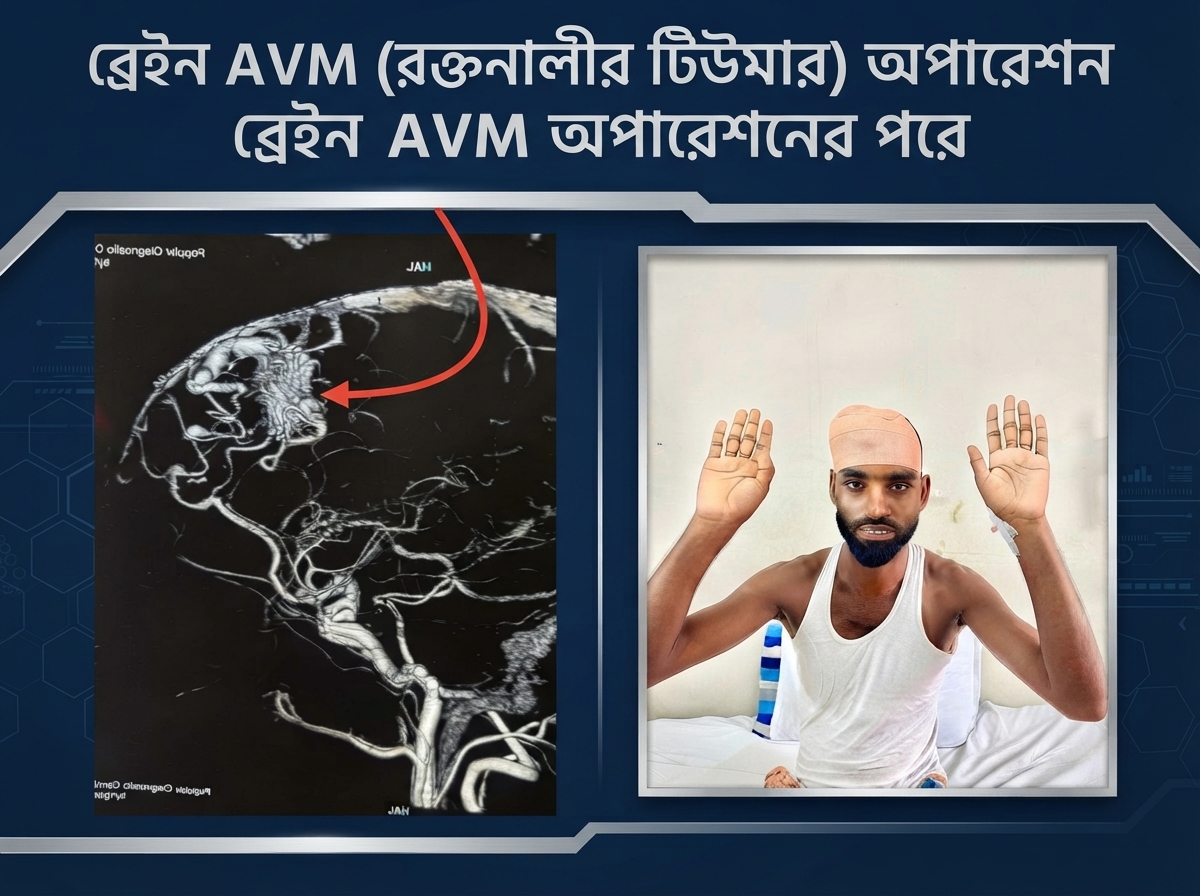
মস্তিষ্কের জন্মগত রক্তনালীর একটি অত্যন্ত জটিল ও বিরল ত্রুটি হলো ব্রেইন এভিএম (Arteriovenous Malformation)। এটি মূলত ব্রেইনের ধমনী ও শিরার সংযোগস্থলে তৈরি হওয়া পেঁচানো রক্তনালীর একগুচ্ছ অস্বাভাবিক থোকা, যা এক ধরণের টিউমারের মতো ছড়িয়ে থাকে।
নিউরোসার্জারির জগতে এটি অন্যতম কঠিন ও অতি-উচ্চ ঝুঁকিপূর্ণ (High Risk) একটি অস্ত্রোপচার। কারণ সার্জারির সময় সামান্য ভুলে বা রক্তনালী ফেটে গিয়ে অতিরিক্ত রক্তক্ষরণের ফলে রোগীর জীবনহানির তীব্র আশঙ্কা থাকে।
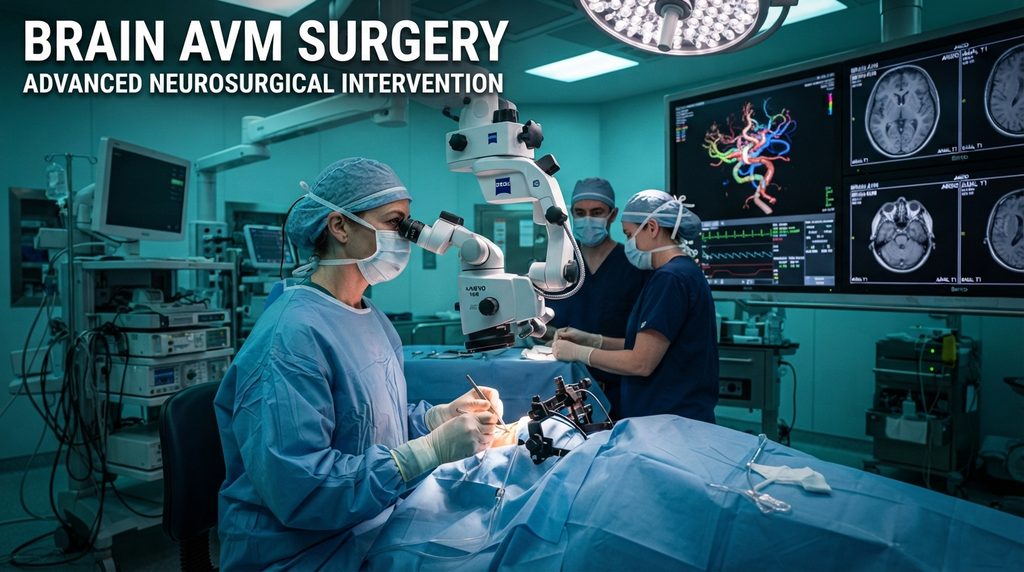
নিখুঁত মাইক্রো-নিউরোসার্জারি: অত্যাধুনিক হাই-পাওয়ার নিউরো-মাইক্রোস্কোপ ব্যবহার করে অত্যন্ত সতর্কতার সাথে মস্তিষ্কের সংবেদনশীল অংশের রক্তনালীগুলোকে সুরক্ষিত রেখে সম্পূর্ণ এভিএম (AVM) সফলভাবে অপসারণ করা হয়েছে।
Brain Arteriovenous Malformation (AVM) Surgery is a complex neurovascular procedure performed to treat abnormal, tangled snarls of arteries and veins in the brain. In a healthy brain, high-pressure arteries feed blood into capillaries, which slow down the blood flow before it reaches low-pressure veins. An AVM bypasses this capillary network, creating direct, high-pressure shunts that risk rupturing and causing severe intracerebral hemorrhage or hemorrhagic stroke.
Over recent years, Bangladesh’s neurovascular hubs have expanded their capabilities, offering microsurgical resection, catheter-based endovascular embolization, and stereotactic radiosurgery within both public and private health networks.
Treatment Modalities Available in Bangladesh
Depending on the AVM’s size, Spetzler-Martin grade, deep brain localization, and blood vessel geometry, surgeons utilize one (or a combination) of three primary strategies:
- Microsurgical AVM Resection (Open Surgery):
- Procedure: A neurosurgeon performs a craniotomy under high-definition 3D microscope magnification to carefully isolate, micro-clip the feeding arteries, preserve normal draining veins, and resect the complete AVM nidus (core).
- Best For: Superficial, compact AVMs in non-eloquent brain regions, providing a definitive, immediate cure.
- Endovascular Embolization (Catheterization):
- Procedure: A neuro-interventionalist feeds a micro-catheter through the femoral or radial artery up to the brain’s blood vessels under fluoroscopic DSA guidance. Liquid embolic agents (such as Onyx or Squid) or micro-coils are injected to block the malformed blood vessels.
- Best For: Reducing AVM size before micro-surgery, closing off deep feeding arteries, or treating small, deep-seated malformations.
- Stereotactic Radiosurgery (Gamma Knife / LINAC):
- Procedure: Delivers targeted high-dose radiation beams directly to the AVM nidus without scalp incisions. Over 1 to 3 years, the radiation causes the abnormal blood vessel walls to thicken and gradually close off.
- Best For: Small, unruptured AVMs situated deep within eloquent brain areas (e.g., brainstem or thalamus) where open surgery poses high functional risks.
Best Hospitals for Brain AVM Surgery in Bangladesh
Comprehensive AVM treatment requires advanced Digital Subtraction Angiography (DSA) suites, 24/7 Neuro-ICU monitoring, continuous intraoperative neuromonitoring, and specialized neuro-anesthesiology support.
Top Specialized Public & Academic Centers:
- National Institute of Neurosciences & Hospital (NINS), Agargaon, Dhaka: The premier specialized public institute for brain and spine conditions in Bangladesh. Equipped with dedicated DSA Cath Labs, hybrid operating suites, and senior neurovascular units offering both surgical resection and endovascular embolization at subsidized costs.
- Bangabandhu Sheikh Mujib Medical University (BSMMU), Shahbag, Dhaka: Features academic neurosurgical units providing pre-operative planning, microsurgery, and long-term neuro-rehabilitation.
- Dhaka Medical College Hospital (DMCH), Dhaka: Equipped to manage high-volume emergency ruptured AVM cases and acute brain hemorrhages.
Top Private Tertiary Hospitals:
- Evercare Hospital (Dhaka & Chattogram): Features modern digital neuro-operating suites, high-magnification ZEISS microscopes, biplane DSA Cath Labs, and dedicated Neuro-ICU care.
- Square Hospital, Dhaka: Offers neuronavigation-guided microsurgery, interventional neuroradiology expertise, and multi-disciplinary tumor/vascular board planning.
- United Hospital & Bangladesh Specialized Hospital, Dhaka: Advanced tertiary facilities equipped for emergency microsurgical clipping/resection, liquid embolic embolizations, and post-stroke critical care.
Costing of Brain AVM Surgery in Bangladesh
The total cost depends on the treatment path (open surgery vs. endovascular embolization vs. combined treatment), the size and complexity of the AVM, hospital stay duration, and embolic material requirements.
| Expense Category | Government Centers (NINS / BSMMU / DMCH) | Top Private Hospitals (Evercare / Square / United) |
| Microsurgical AVM Resection | BDT 90,000 – BDT 250,000 (Out-of-pocket consumables) | BDT 450,000 – BDT 950,000+ |
| Endovascular Embolization (Per session) | BDT 120,000 – BDT 300,000 (Excl. embolic agents) | BDT 400,000 – BDT 850,000+ |
| Neuro-ICU / HDU Stay (Per Day) | Subsidized / BDT 1,500 – 4,000 | BDT 20,000 – 45,000 |
| Embolic Material (Onyx / Coils / Glue) | BDT 60,000 – 180,000 | BDT 120,000 – 350,000+ |
Note: Diagnostic Cerebral Angiogram (DSA) costs range from BDT 15,000 to BDT 45,000, while pre-op 3D CT/MR Angiograms incur separate diagnostic fees.
Frequently Asked Questions (10 FAQs)
1. What is a Brain AVM?
A Brain Arteriovenous Malformation (AVM) is an abnormal, tangled snarl of blood vessels connecting arteries directly to veins in the brain, disrupting normal blood flow and risking rupture.
2. What are the common symptoms of a Brain AVM?
Key signs include sudden severe headaches, unexplained seizures, progressive neurological weakness or numbness, double vision, and symptoms of internal brain hemorrhage (vomiting, neck stiffness, confusion).
3. Is a Brain AVM congenital or inherited?
Most brain AVMs are congenital—meaning they form during fetal development—and are rarely inherited or passed down genetically through families.
4. How is a Brain AVM diagnosed in Bangladesh?
Diagnosis is established using magnetic resonance imaging (MRI), CT Angiography (CTA), and confirmed through a gold-standard diagnostic Cerebral DSA (Digital Subtraction Angiography).
5. Which is better: Open Microsurgery or Endovascular Embolization?
Open microsurgery offers immediate, complete removal of superficial AVMs. Embolization is less invasive and is often used to shrink complex AVMs before surgery or treat deep feeding vessels.
6. Is Brain AVM treatment available in government hospitals in Bangladesh?
Yes. Government specialized institutes like NINS (Agargaon) perform microsurgical resections and endovascular embolization procedures regularly at government-subsidized rates.
7. How long does Brain AVM surgery take?
Microsurgical AVM resection typically takes between 4 to 8 hours depending on complexity, while endovascular embolization procedures take approximately 2 to 4 hours.
8. What is the hospital recovery period after AVM surgery?
Unruptured, planned AVM surgeries typically require 1 to 3 days in the Neuro-ICU followed by 4 to 7 days in a ward. Ruptured AVMs with severe bleeding may require several weeks of critical care and rehabilitation.
9. Can a Brain AVM return after complete surgical removal?
If post-operative DSA angiograms confirm complete excision of the AVM nidus, recurrence in adults is extremely rare.
10. When can a patient resume work and physical activities?
For unruptured cases, patients generally return to light work within 4 to 8 weeks. Heavy lifting, strenuous exercise, and contact sports should be avoided until full neurovascular clearance is granted by the surgeon.